

Coin Defect Detection: LED Panels and Diffusers
Finding small surface defects becomes a necessary step in coin study, measuring work, and checking coin values.
Correctly checking the coin’s condition, or the metal object’s condition, needs lighting methods capable of showing differences in bad surface spots without adding bad light effects.
Normal methods, using general or uncontrolled light, often hide thin defects, such as tiny scratches, minimal wear on the field, or shallow hits.
To reach a high level of detail, using special equipment is required, including controlled light sources, such as LED panels, and light-shaping elements, specifically diffusers.

Surface Interaction
Light hitting this surface reflects, bends, and scatters, depending on the angle the light hits, the local slope of the surface, and its texture.
Small defects, being local changes in shape, change the reflection angle of the light, causing shadows or bright reflections to appear.
Light Control Settings
Too much light can cause overexposure, hiding defects with bright spots. Not enough light makes the difference unclear.
Angle between the light coming down and the line straight up from the coin’s surface — the most useful for finding small relief changes.
Changing the light’s angle allows for controlled shadow making from defects.
Although neutral white light is preferred for most metal surfaces, some defects, for example, rust or dirt remaining, can show differences better with narrow-band light.
LED Panels
Light-emitting diode panels are the chosen light source for technical checks, giving good operating and lighting features.
Advantages
- Giving enough brightness with low heat, this stops the heat effect on the object being looked at
- Ensuring steady light settings over a long time of use
- Good LED parts keep the same color temperature and Color Rendering Index, making sure results can be repeated
- The design of panels, having many small light points, makes the light shine evenly on an area bigger than a coin
- Most panels have electronic dimmers, allowing for smooth control of light strength
Technical Steps
Choosing sources with a color temperature of 5500 K, copying daylight, is recommended.
The CRI number should be at least 90, as a high CRI ensures the correct showing of all colors, making it needed for finding cleaning signs or patina.
Panels must have a high-frequency Pulse Width Modulation system or use direct current, stopping flickering.
Flickering can change how things look and create bad spots when taking pictures.
Role and Types of Diffusers
A diffuser is an optical part that changes direct or point light into a soft, spread-out flow.
Spreading the light is necessary for softening shadows and stopping sharp reflections on shiny coin areas.
Diffuser Working Principles
The diffuser works through many light bends and reflections inside the material, causing the light angle to widen and changing a direct source into an effective, large area secondary source.
Diffuser Types Used in Checking
- The simplest type. Placed between the LED panel and the coin. Creating soft but somewhat directed light.
- Shaped like a half-sphere or a cut cone, having inside reflecting surfaces and a spreading film. Giving almost shadow-free light, as light hits the object from all sides. Used for finding general wear and patina, but is less good for finding small relief changes.
- The light source is placed in a ring shape, with the diffuser spreading the light evenly around the edge. Used for making sure the light is even with no clear shadows.
Finding Defects Using LED
To find different types of surface problems well, a special lighting arrangement or a coin scanner app is used.
Angled Lighting
The light source is placed at a small angle to the coin’s flat surface.
The light angle is from 5 to 30 degrees compared to the flat surface.
Effect: Any small bump or dip on the surface throws a long, clear shadow. The length and clarity of the shadow change directly with the defect’s height/depth and indirectly with the light’s angle. The smaller the angle, the longer the shadow and the clearer the difference.
Flat Lighting
One or more spread light sources are used, placed straight up from the viewing line or at a wide angle, working to make shadows small.
- Checking the coin’s general field condition
- Finding color changes: signs of cleaning, chemical leftovers, and patina changes
- Finding big defects, like rust spots or heavy mechanical damage, that do not need clear shadowing
Shadow Dome
The coin is placed inside a light dome or under a ring diffuser, where light comes from the widest possible range of angles.
Creating an almost shadow-free image, used for careful checking of patina, shine of the field, and relief, also for showing the coin’s look without light reflection problems.
Specific Defect Types
The choice of lighting method is set by the type of defect needing to be found.
Scratches and Micro-cracks
Scratches are line-shaped dips.
- Best Method: Angled lighting
Turning the coin or the light source, making sure the light direction is straight across from the scratch’s direction.
The clearest shadow difference is achieved when the light direction is side-by-side with the scratch, causing the scratch walls to throw long shadows.
Dents and Hits
Hits are local, often rounded or badly shaped dips.
- Best Method: Angled lighting at several angles
Light hitting the dip reflects at a different angle than light from the undamaged field.
During inspection, changing the viewing angle or the light’s angle is necessary.
Bright reflections or clear shadows can appear on the hit walls, depending on the defect’s shape.
Wear and Rub Marks
Wear is the flattening of the original relief and small surface texture. Rub marks are areas where the shine is broken.
- Best Method: Combining flat and angled lighting, and the best coin identifier app checking
Angled lighting, used at a really small angle, finds the flattening of the relief tops.
In the worn area, the shadow from the relief will be less clear and shorter than in areas not damaged.
Setting up Equipment and Work Process
Setting up the lighting system must be done in an organized way, allowing for the same result every time.
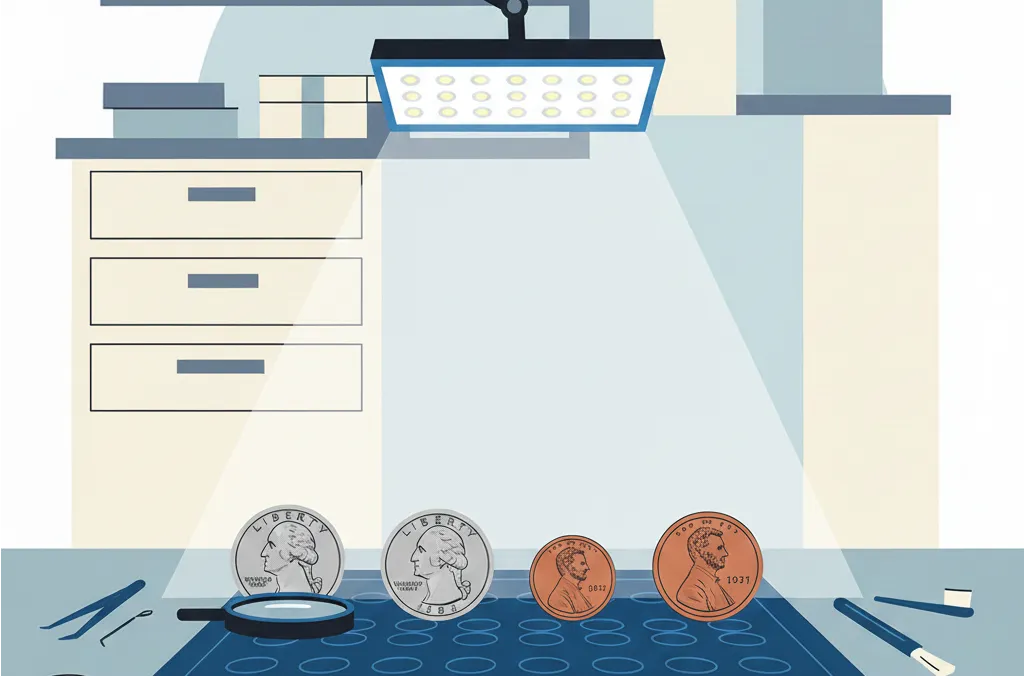
Controlling Angle and Distance
For angled lighting, the LED panel must be fixed on a stand or holder, letting you set the angle exactly.
Using an angle finder to set 5°, 15°, and 30° angles is recommended, as these are standard angles for most checks.
The greater the distance, the more even the light, but the less strong it is, a good distance is 1-2 times the panel size.
Setting Light Strength
The light strength must be chosen to give the greatest difference between the defect and the coin field without oversaturating the brightest parts.
LED panel dimmers and camera exposure histograms are used for this.
Using Two Sources
Using two LED panels, with separate control of angle and strength, allows getting relief information at the same time in two angles straight across from each other, making it needed for finding the shape of complex defects in space.
Practical Work Process Tips
- Starting with even lighting for general checking of patina, color, and shine is needed
- Defects unseen with northern light can become clear with western light
- Picture taking must happen at the same light angle, making the defect clearest
- Using a black or dark grey dull background under the coin stops uncontrolled reflections.
So, the way to find the smallest defects is Angled Lighting, where the spread light from the LED panel hits the coin at a small angle, making the difference in local shape changes much bigger.
Flat Lighting adds to the process, allowing for checking for color and texture problems not tied to the relief. An organized way of setting light strength, angle, and color makes sure the results are true and repeatable, making them needed for correctly checking the object’s condition.
Latest Articles
- Coin Defect Detection: LED Panels and Diffusers
- Modern Rarities: Premium-Appraised Quarters Released in 2020s
- Old Age Is a Joy Nowadays: Free Games That Will Help to Boost Your Memory

- The Historical Significance of Coins Depicting Sports
- Mental Training for the Self: How to Stay You Without Disappearing in Others